
Your return for tax year 2026 (the one you file in early 2027) has new deductions for tips, overtime, car loan interest and seniors, new rules for charitable gifts, bigger childcare tax help, and a health-insurance change that can turn a refund into a bill. Most of this comes from the Working Families Tax Cuts Act (formerly the "One, Big, Beautiful Bill Act", Public Law 119-21), signed July 4, 2025, which also made many 2017 tax cuts permanent. Here is what changed, who it affects, and what to do before December 31.
Which tax year is which
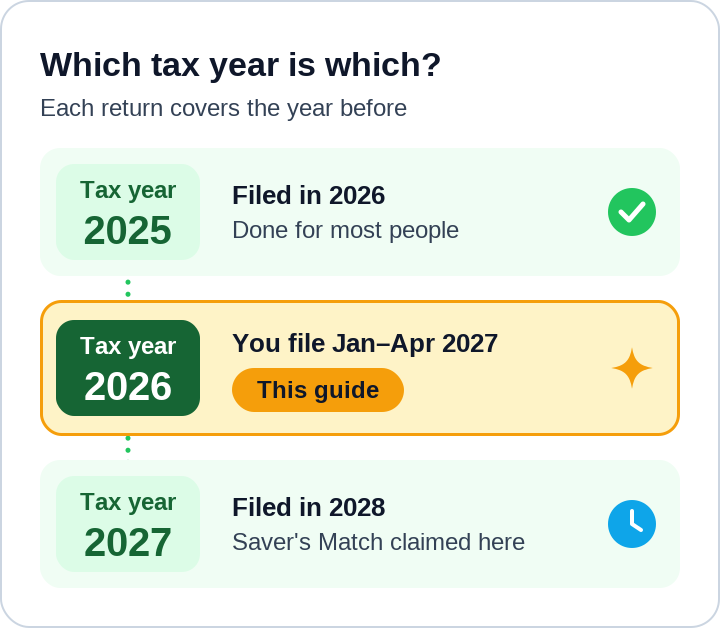
Everything below is about tax year 2026: income you earn this calendar year, reported on the return you file in the January through April 2027 filing season.
Key 2026 numbers at a glance
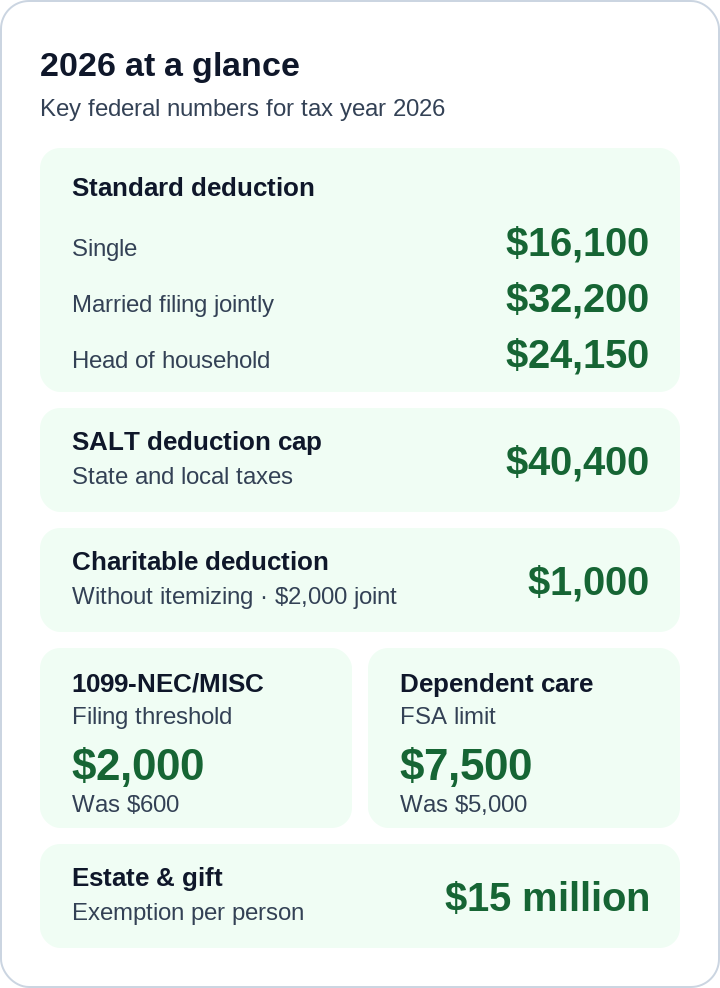
The standard deduction is $16,100 single or married filing separately, $32,200 married filing jointly and $24,150 head of household. The cap on deducting state and local taxes (SALT) is $40,400 ($20,200 married filing separately). For most filers it shrinks once income passes $505,000, but never below $10,000; separate filers have lower limits. For Bay Area homeowners paying California income tax and property tax, that higher cap may make itemizing worth another look.
New deductions for workers and seniors
Four new deductions apply for tax years 2025 through 2028. You claim them on Schedule 1-A, whether or not you itemize. They reduce income tax only; Social Security and Medicare tax still apply.
- Tips: up to $25,000, only for occupations on Treasury's final list (more than 70 occupations).
- Overtime: up to $12,500 ($25,000 married filing jointly), but only the extra "half" of federally required time-and-a-half counts, even if your employer pays double time. Overtime premiums required only by state law or a union contract don't qualify.
- Car loan interest: up to $10,000 a year on a loan for a new, U.S.-assembled vehicle for personal use.
- Seniors 65+: an extra $6,000 per person ($12,000 if both spouses qualify), on top of the existing additional standard deduction.
Each has its own income phase-out. These are federal deductions, and California may treat them differently. Details in No Tax on Tips and Overtime? What Really Qualifies in 2026.
Charitable giving and itemizing
How your gifts count now depends on whether you itemize.
- Standard deduction: you can deduct up to $1,000 of cash gifts ($2,000 married filing jointly) on a new line of Form 1040. Gifts to donor-advised funds and private foundations generally don't count, and you can't combine this with itemizing.
- Itemize: only total gifts for the year (cash and non-cash) above 0.5% of your adjusted gross income (AGI) count.
See Giving and Itemizing in 2026: What to Know Before December 31 for help choosing.
Families: childcare, health coverage and the Saver's Match
The child and dependent care credit top rate rises to 50% (from 35%); the rate gets smaller as income rises. Expense caps stay at $3,000 (one child) and $6,000 (two or more), so the maximum credit is now $1,500 or $3,000. The dependent care FSA limit rises to $7,500 (from $5,000). You can't use the same expenses for both, so check your FSA election during open enrollment.
The Saver's Match starts with 2027 contributions: the government deposits up to $1,000 a year into your retirement plan or IRA (50% of up to $2,000 you save), for savers within income limits. There is nothing to do for 2026. More in Childcare, Health Coverage and the Saver's Match: 2026 Family Changes.
Trump Accounts for children
About 70 million Trump Accounts now exist after the government finished auto-enrolling eligible children on October 1, 2026. An account can't receive money until a parent claims it, and the one-time $1,000 Treasury deposit for children born 2025 through 2028 needs its own election. Family, friends and employers together can add up to $5,000 a year, and California has followed the federal tax treatment since July 2026. See Trump Accounts: How to Claim Your Child's Account and the Tax Rules for claiming steps, tax rules and 529 comparisons.
If you own a business
- QBI deduction: permanent at 20%, with a new $400 minimum if you have at least $1,000 of active business income.
- Paying contractors: for payments made in 2026, you file 1099-NEC or 1099-MISC only at $2,000 or more (was $600). 1099-K is back to $20,000 and 200 transactions.
- Payroll: 2026 W-2s must show qualified tips (box 12, code TP), qualified overtime (code TT) and the tipped-occupation code (box 14b).
- Credits: employer childcare credit cap $500,000 ($600,000 for eligible small businesses); paid family and medical leave credit extended, now covers insurance premiums.
- Trump Accounts: you may contribute up to $2,500 per employee per year to employees' children's accounts.
If your income or estate is large
The alternative minimum tax (AMT) exemption is $90,100 single (phase-out starts at $500,000) and $140,200 married filing jointly (phase-out starts at $1,000,000). The estate and gift tax exemption is $15 million per person, now permanent. If your income reaches the 37% bracket, itemized deductions are trimmed so each dollar saves at most about 35 cents; see our itemizing guide.
Energy credits that ended
If you bought an EV or installed solar recently, check these dates.
| Credit | Ended for |
|---|---|
| EV credits, new, used and commercial (30D, 25E, 45W) | Vehicles acquired after Sept 30, 2025 |
| Home energy improvements (25C) | Property placed in service after Dec 31, 2025 |
| Solar and other residential clean energy (25D) | Expenditures after Dec 31, 2025 (installation had to be complete by then) |
| EV charger and refueling property (30C) | Property placed in service after June 30, 2026 |
The commercial buildings deduction (179D) and new energy-efficient home credit (45L) also ended for construction beginning or homes acquired after June 30, 2026.
Other changes worth knowing
Sending money abroad. A 1% tax applies to money sent overseas after December 31, 2025 when paid with cash, a money order or a cashier's check. Bank-account and card-funded transfers are not taxed.
Disaster relief. Federal deadline postponements now extend to qualified state-declared disasters, with an automatic postponement of up to 120 days (was 60). The casualty loss deduction also covers state-declared disasters, which matters for California wildfire seasons.
Gambling losses. You can now deduct only 90% of your losses, and still no more than your winnings.
Clearer IRS notices. Math-error notices must explain the error in plain language and tell you how to ask the IRS to reverse it (IRS Math and Taxpayer Help Act, November 25, 2025).
Immigration and refundable credits. Treasury has proposed rules (not yet final) that would limit the refundable portion of four credits (earned income, child tax, American Opportunity and adoption) for certain non-citizens. If you may be affected, please talk to us.
New forms you may receive: Form 5498-TA (Trump Account contributions), Form 1098-VLI (car loan interest) and Form 1099-LPS (long-term care premiums).
What to do now
- Estimate whether you'll itemize or take the standard deduction before December 31. Your charitable strategy depends on it.
- Claim your child's Trump Account if you haven't, and for a child born 2025 through 2028, separately elect the $1,000 deposit.
- Check your dependent care FSA at open enrollment (limit rose to $7,500).
- Update your income estimate with Covered California or your marketplace if you receive advance Premium Tax Credits. Repayment caps are gone.
- Review your W-2 in January 2027 for codes TP (tips), TT (overtime) and your tipped-occupation code in box 14b.
- Gather records for new deductions: pay stubs, tip logs, car loan documents, Form 1098-VLI and proof of U.S. vehicle assembly.
How FK Services can help
- We can run a year-end projection to see whether itemizing or the standard deduction saves you more.
- We'll review your W-2s, 1099s and Form 1098-VLI so you claim the deductions you qualify for, and check how each change applies to your state return, since California doesn't automatically follow federal changes.
- If you receive marketplace health insurance, we can estimate your Premium Tax Credit and flag any excess you may need to repay.
- We help parents claim Trump Accounts and advise on how they fit alongside 529 plans.
- For business owners, we can update your 1099 filing list for the new $2,000 threshold and check that payroll is ready for the new W-2 codes.
This article is general information based on federal law and IRS guidance as of November 2026. It is not tax, legal, or investment advice. Rules can change, and your situation may differ, so please contact us before acting.
Need Tax Guidance Now?
Contact FK Services today for personalized tax planning and compliance support tailored to your Bay Area business.
📧 Email: team@fk-services.com
📱 Text: (510) 320-1101
📍 Visit: 5500 Stewart Ave, #116, Fremont, CA 94538