

For tax year 2026 (the return you file in 2027), the Working Families Tax Cuts Act expanded childcare tax help and changed how health-insurance credits are paid back. A new Saver's Match from an earlier retirement law (SECURE 2.0) begins in 2027. If you pay for childcare, buy coverage through Covered California, or save for retirement on a modest income, this article is for you.
Childcare: a bigger credit and a bigger FSA
The child and dependent care credit
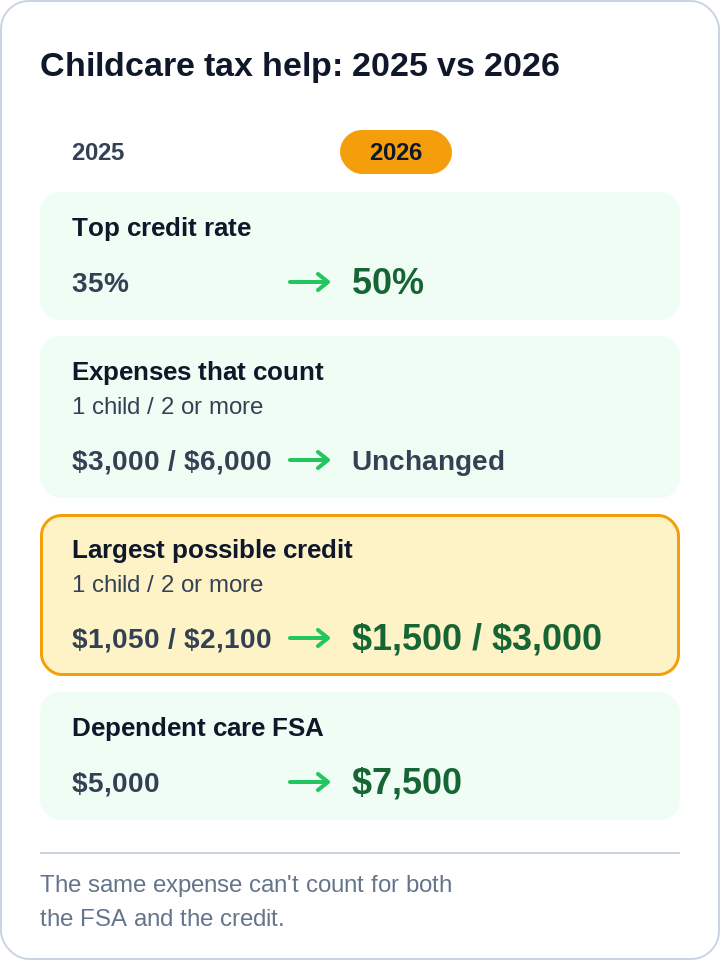
If you pay for care for a young child or a dependent who cannot care for themselves so that you (and your spouse, if married) can work, you can claim a tax credit on your return. For 2026, the top credit rate jumps to 50% of your qualifying expenses, up from 35%. That top rate applies at lower incomes and phases down as your income rises (the schedule is in the Form 2441 instructions), so the biggest gains go to lower- and middle-income families. We can check which rate applies to you.
The dollar limits on qualifying expenses have not changed: up to $3,000 for one child or dependent and $6,000 for two or more. At the new 50% top rate, the largest possible credit is $1,500 for one child or $3,000 for two or more.
Dependent care FSA
If your employer offers a dependent care flexible spending account, the most you can set aside tax-free rises to $7,500 for 2026, up from $5,000. If you are married filing separately, the limit is $3,750. This amount is not indexed for inflation, so it stays at $7,500 until Congress changes it.
One important rule: the same expense cannot count for both the FSA and the credit. Because the FSA limit ($7,500) is now larger than the credit's expense cap ($3,000 or $6,000), families who use the full FSA often have little or nothing left for the credit. Which approach saves more depends on your income and care costs, and we can run the numbers for your situation.
Fall open enrollment sets your election for 2027. If your care costs are that high, check whether your employer's plan allows the higher $7,500 limit and consider raising your 2027 election.
Covered California: why your refund could become a bill
If you buy coverage through Covered California and get help paying your premiums each month (advance premium tax credits), two changes affect your 2026 return.
In recent years, Congress temporarily expanded the premium tax credit so that households above 400% of the federal poverty level could still receive help. That expansion expired after 2025. Starting with tax year 2026, there is no credit at all if your household income exceeds 400% of the federal poverty level. Not sure how close you are to that line? Send us your Covered California paperwork and we will check.
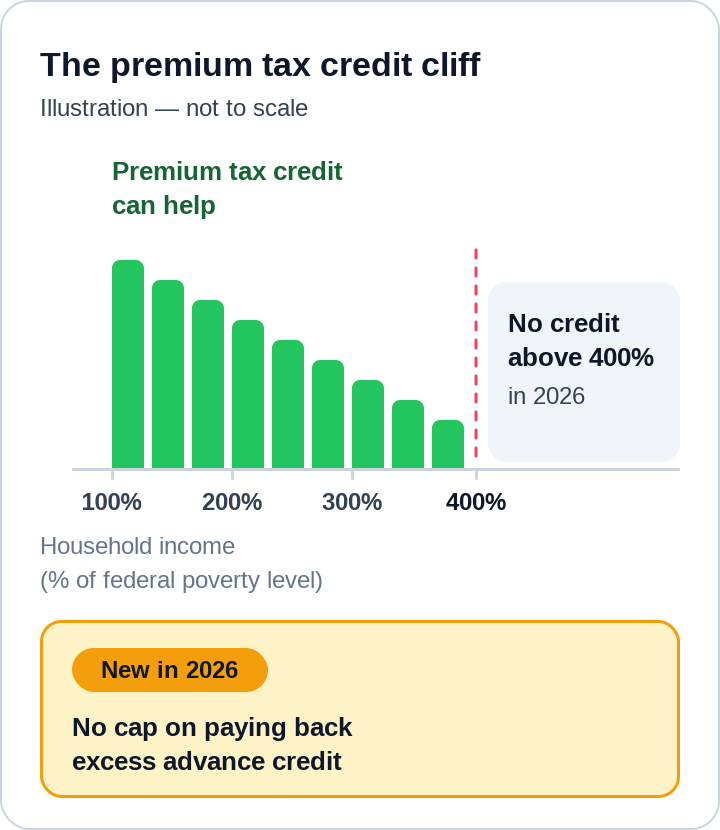
Two steps make sense now. First, update your income estimate with Covered California or your marketplace so the rest of your advance credit reflects your real income. Second, if your 2026 income ended up higher than you estimated, plan for a possible balance due when you file in 2027. Updating late in the year cannot undo extra credit already paid in earlier months. Set cash aside, or ask us whether to raise your withholding or make an estimated payment.
The Saver's Match: a government deposit into your retirement account
This change takes effect for contributions made starting in 2027, so there is nothing to claim on your 2026 return. But it is worth understanding now so you can plan ahead.
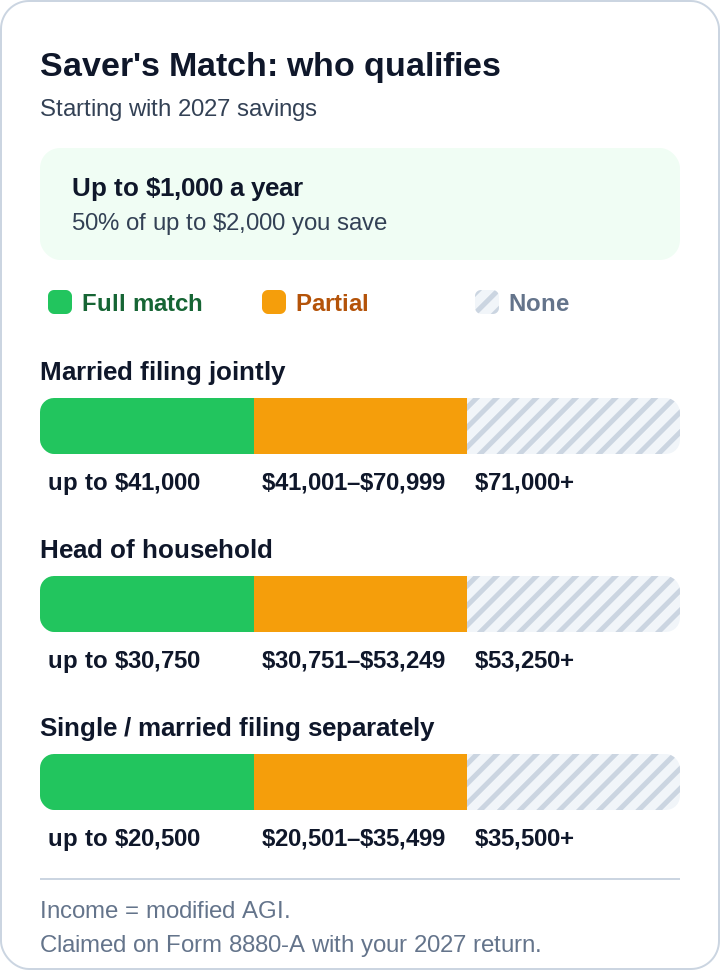
Starting in 2027, the Saver's Match largely replaces the Saver's Credit, which will continue only for ABLE account contributions. The existing Saver's Credit still applies to your 2026 return, so ask us whether you qualify. Instead of a tax credit, the government will deposit up to $1,000 a year directly into your 401(k)-type plan or IRA. The match is generally 50% of up to $2,000 you contribute, and it shrinks as income rises. If your calculated match would be under $100, you can elect to receive it as a refundable tax credit instead.
You can qualify even if you owe little or no federal income tax. Given Bay Area incomes, this is most likely to help part-time workers and young adults on their own.
Who qualifies
You must meet all of these requirements:
- Contribute to a retirement plan or IRA in your own name
- Be at least 18 by the end of the tax year
- Not be claimed as a dependent on someone else's return
- Be a U.S. resident for tax purposes
- Not be a full-time student
Income limits
The match depends on your modified adjusted gross income (MAGI) and filing status:
| Filing status | Full | Partial | None |
|---|---|---|---|
| Married filing jointly or qualifying surviving spouse | Up to $41,000 | $41,001–$70,999 | $71,000+ |
| Head of household | Up to $30,750 | $30,751–$53,249 | $53,250+ |
| Single or married filing separately | Up to $20,500 | $20,501–$35,499 | $35,500+ |
You will claim the Saver's Match on Form 8880-A when you file your 2027 return in early 2028. The IRS is still writing the detailed rules. We will update clients as guidance arrives.
Saving for children: Trump Accounts
Most U.S. children now have a Trump Account, but it must be claimed before it can receive money, and the $1,000 deposit for children born 2025 through 2028 needs its own election. Our Trump Accounts guide walks through the steps and tax rules.
California note
California does not automatically follow federal tax changes, so your state return may treat these items differently. We will check that when we prepare your return. For Trump Accounts, California changed its law in July 2026 to follow the federal rules.
What to do now
- Parents with childcare costs: If your employer offers a dependent care FSA and open enrollment is under way, check whether your plan allows the new $7,500 limit and consider raising your 2027 election.
- Covered California enrollees: Before December 31, update your 2026 income estimate, and plan for a possible balance due when you file. There is no longer a cap on paying back excess advance credit.
- Savers with modest incomes: Starting January 2027, contribute to a workplace retirement plan or IRA in your own name (ask your employer whether it offers a plan), and keep records of what you put in. The match is claimed on your 2027 return in 2028.
- Parents of children under 18: Claim your child's Trump Account if you have not done so already. If your child was born in 2025 through 2028, separately elect the $1,000 deposit.
- When you file in early 2027: Bring your childcare provider receipts and your Covered California tax form so we can reconcile your credits. See our guide to what's new on your 2026 return for the full picture.
How FK Services can help
- We can compare the childcare credit and the dependent care FSA to find the best combination for your family's income and care expenses.
- If you are on a marketplace plan, we can estimate your premium tax credit and flag any repayment risk before you file.
- We will help eligible clients prepare for the Saver's Match in 2027 and claim it on Form 8880-A when the time comes.
- We can walk you through claiming a Trump Account and explain how future distributions will be taxed.
- We review both your federal and California returns so you are not caught off guard by differences in state treatment.
This article is general information based on federal law and IRS guidance as of November 2026. It is not tax, legal, or investment advice. Rules can change, and your situation may differ, so please contact us before acting.
Need Tax Guidance Now?
Contact FK Services today for personalized tax planning and compliance support tailored to your Bay Area business.
📧 Email: team@fk-services.com
📱 Text: (510) 320-1101
📍 Visit: 5500 Stewart Ave, #116, Fremont, CA 94538