

For tax year 2026 (the return you file in 2027), giving to charity works differently depending on how you file. If you take the standard deduction, you can now deduct up to $1,000 of cash gifts ($2,000 married filing jointly). If you itemize, the first 0.5% of your income in gifts no longer counts, and the SALT cap and a few other itemized deductions changed too. Gifts must be made by December 31 to count for 2026.
For everything else that changed, see What's New on Your 2026 Tax Return.
The first question: standard deduction or itemize?
Before you plan your year-end giving, you need to know which path you are on. The 2026 standard deduction is:
- $16,100 for single filers and married filing separately
- $32,200 for married filing jointly
- $24,150 for head of household
If your total itemized deductions (state and local taxes, mortgage interest, charitable gifts above the 0.5% floor, and the rest) add up to more than your standard deduction, you itemize. If not, you take the standard deduction. Each path now has its own charitable deduction with its own rules.
SALT cap: $40,400 for 2026
For many Bay Area households, the state and local tax (SALT) deduction is the biggest factor in whether itemizing makes sense. For 2026, the SALT cap is $40,400 (or $20,200 if married filing separately).
For most filers, that cap is reduced if your modified AGI exceeds $505,000, but it can never drop below $10,000 (married couples filing separately have lower limits). The cap rises by 1% each year through 2029, then returns to $10,000 in 2030.
With the cap now at $40,400, California income tax and property tax alone may be enough to put some Bay Area households over the standard deduction. If so, you are itemizing anyway, and your charitable gifts follow the itemizer rules below, including the 0.5% floor. If your state and local taxes are lower, mortgage interest plus charitable gifts may be what tips you into itemizing. It is worth running the numbers.
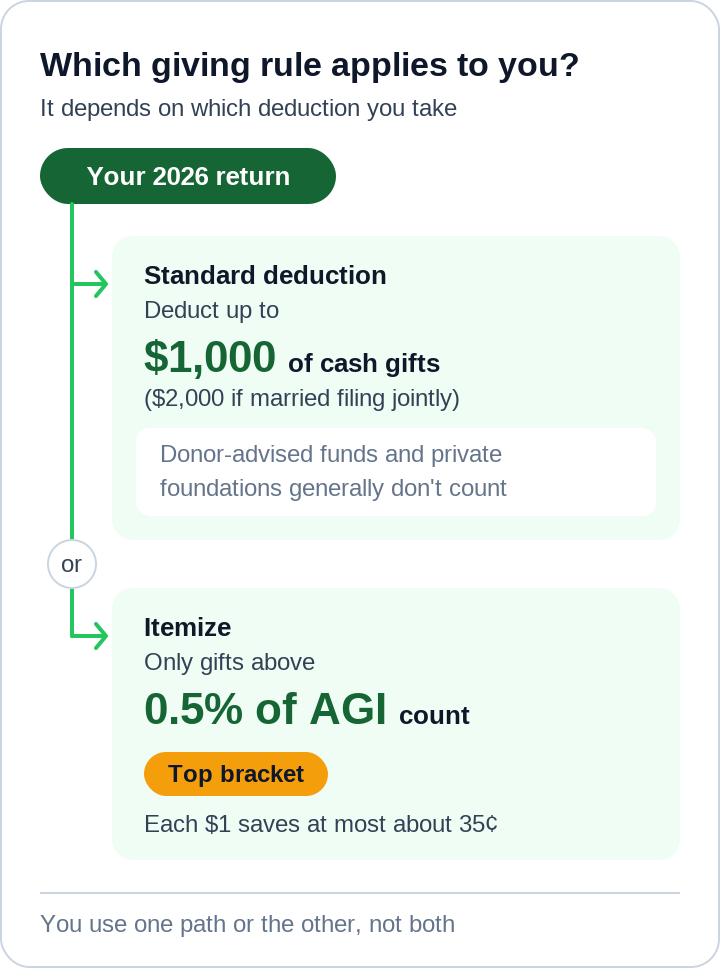
If you take the standard deduction: a new deduction for cash gifts
A charitable deduction for people who take the standard deduction is back, and the Working Families Tax Cuts Act made it permanent. Starting in 2026, you can deduct up to $1,000 in cash gifts to qualifying charities. If you are married filing jointly, that limit is $2,000. This shows up as a new line on Form 1040, taken in addition to your standard deduction.
If you take the standard deduction, the plan is simple:
- Cash only. Donations of clothing, furniture, stock, or other property do not count for this deduction.
- Gifts to donor-advised funds and private foundations generally don't qualify. Give directly to the charity instead.
- You can't combine this with itemizing. It is one or the other. If you itemize your deductions, this line does not apply to you.
Give cash directly to your church, food bank, or other qualifying charity, keep the receipt, and claim it.
Other new deductions you can take without itemizing, such as the extra deduction for people 65 and older, are covered in our guide to the tips, overtime, car loan and senior deductions.
If you itemize: the new 0.5% floor
Itemizers can still deduct charitable contributions on Schedule A, but there is a new threshold. For 2026, only the portion of your charitable gifts that exceeds 0.5% of your adjusted gross income (AGI) is deductible. The floor applies to your total gifts for the year, including non-cash donations.
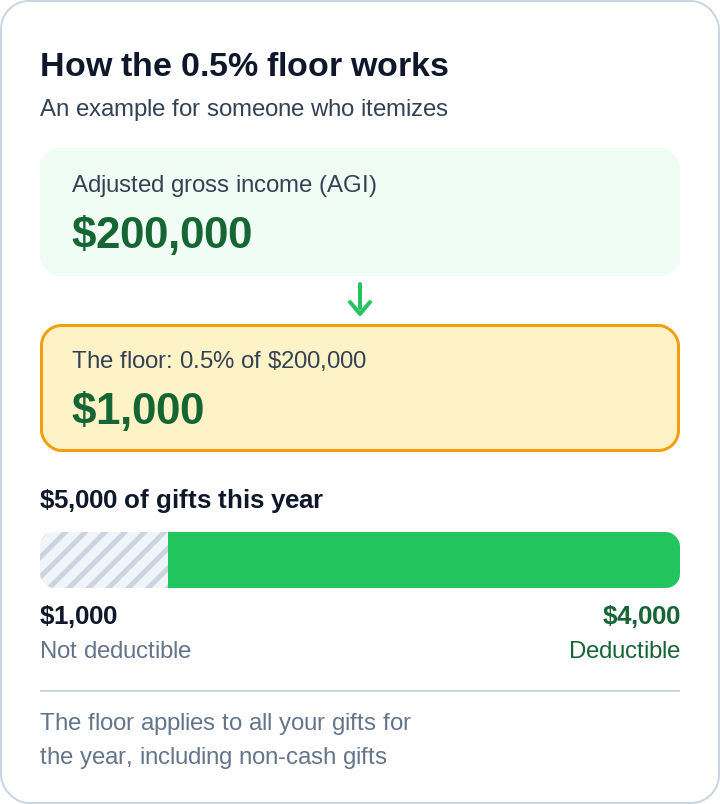
For most people the floor is small. But if you give a few hundred dollars a year, it can wipe out most or all of your deduction.
Itemizers: consider bunching two years of gifts into one
Because of the 0.5% floor, itemizers may benefit from concentrating two or more years of giving into a single tax year. This is sometimes called "bunching."
Bunching means giving two years' worth of gifts in one year and little or nothing the next. It can help in two ways. You pay the 0.5% floor once instead of twice, and a bigger gift year may push your itemized total above the standard deduction. If you end up taking the standard deduction in the off year, you can still deduct up to $1,000 ($2,000 joint) of cash gifts made directly to charity.
A donor-advised fund can make bunching practical. You contribute a lump sum to the fund in one tax year and claim the deduction that year, then recommend grants to your favorite charities over the following months or years. The charities still receive steady support, but you get the tax benefit up front. Donor-advised funds work for itemizers doing a bunching strategy, but gifts to a donor-advised fund generally don't qualify for the non-itemizer deduction.
Other Schedule A changes
A few more changes affect itemizers in 2026:
- Mortgage insurance: Premiums for PMI and FHA, VA or USDA loans count as mortgage interest again starting in 2026, but only if your AGI is under $109,000 ($54,500 married filing separately). The deduction shrinks above $100,000, and these limits don't rise with inflation, so many Bay Area homeowners won't qualify. If your income is under the limit and you pay mortgage insurance, make sure we see your mortgage statement.
- Casualty losses: The deduction now covers state-declared disasters, not just federally declared ones. This matters for California wildfire seasons.
- Gambling losses: If you itemize gambling losses, they are now capped at 90% of your losses (still limited to your total gambling winnings for the year).
- Educator expenses: Educators keep the $300 above-the-line deduction. New for 2026, they can also itemize unreimbursed work expenses beyond that $300 on Schedule A.
High earners: deductions are worth a little less at the top
If your income reaches the 37% tax bracket (for 2026, that starts at $640,600 for single filers and head of household, $768,700 for married filing jointly), there is an additional limitation. Your total itemized deductions are trimmed so that each dollar of deductions saves you at most about 35 cents instead of the full 37 cents.
This does not eliminate the benefit of giving, but it slightly reduces the tax savings at the highest income levels. If you are in this range, talk to us before making large year-end gifts.
For most taxpayers above $505,000 in modified AGI, the SALT cap also begins to phase down (but never below $10,000).
What to do now
- Estimate whether you will itemize. Add up state income and property taxes (up to $40,400), mortgage interest, and planned gifts above the 0.5% floor, then compare the total with your standard deduction.
- Taking the standard deduction? Give cash directly to charity by December 31 and keep the receipt. Up to $1,000 ($2,000 joint) counts.
- Itemizing? Decide on bunching before December 31. If your gifts only just clear the 0.5% floor, consider moving next year's giving into December 2026, directly or through a donor-advised fund.
- High income? Talk to us before making large year-end gifts.
- Send us your receipts and tax documents in January so we can confirm the best approach for your 2026 return.
How FK Services can help
- We can run a standard-deduction-vs.-itemize comparison with your actual numbers, so you know which path saves you more.
- If bunching or a donor-advised fund strategy makes sense for you, we can model the multi-year impact.
- We will check how California treats these federal changes on your state return.
- If you are a high earner, we can show what an extra gift will actually save you after the top-bracket limit.
- We prepare your Schedule A and apply the new limits for you.
This article is general information based on federal law and IRS guidance as of November 2026. It is not tax, legal, or investment advice. Rules can change, and your situation may differ, so please contact us before acting.
Need Tax Guidance Now?
Contact FK Services today for personalized tax planning and compliance support tailored to your Bay Area business.
📧 Email: team@fk-services.com
📱 Text: (510) 320-1101
📍 Visit: 5500 Stewart Ave, #116, Fremont, CA 94538